Treasure Hidden in a Field by David W. Jorgensen
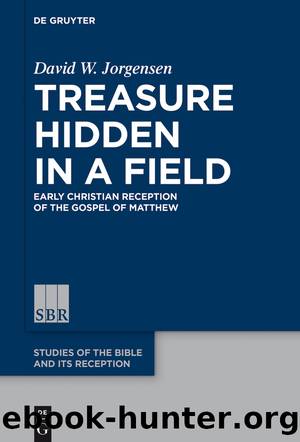
Author:David W. Jorgensen
Language: eng
Format: epub
Publisher: Walter de Gruyter
Published: 2016-02-15T00:00:00+00:00
2The Divine Law
Jesusâ categorical statement of Matthew 5.17, âThink not that I have come to destroy the law or the prophets; I have come not to destroy but to fulfill,â has become a locus classicus for the orthodox Christian relationship to Judaism, interpreted as indicating continuity yet supersessionism. This was not always the case. Standing as preface to the antitheses and as introduction to the main part of the Sermon on the Mount,563 Mt. 5.17â20 as a whole is generally considered to be one of the most Jewish passages of the canonical gospels. Jesusâ claims that not a jot or tittle of the law will pass away until heaven and earth do so (5.18), that whoever breaks one of the least of the commandments of the Torah will be called least in the Kingdom of Heaven (5.19), and that entry to the Kingdom is barred to those whose righteousness does not exceed those of the scribes and the Pharisees (5.20) all underscore the fact that Jesusâ message, according to Matthew, is one fully consistent with Jewish teaching and scriptural interpretation; indeed, vv. 18â20 may sound like rabbinic orthodoxy.564 The six so-called âantithesesâ following (vv. 21â48) are understood by virtually all commentators as examples of the kind of thing Matthewâs Jesus meant by âfulfillingâ the law in v.17; they all, in one way or another, promote a stricter code of ethics than what is stipulated in âthe letter of the law.â Together, Mt. 5.17â48 represents a line of Jewish scriptural interpretation with a great deal in common with Pharisaical tradition, and fully consistent within what many Matthew scholars have recognized as Matthewâs âChristian-Jewish Community.â565
That Gentile Christianity should adopt â indeed, lean upon â such teachings as foundational to their understanding of the Jewish law is, in this view, surprising. It did not always look upon these verses favorably, as a review of both the Ante-Nicene Fathers and Biblia Patristica lists of scriptural citations and allusions will reveal. The verses Mt. 5.17â20 are not quoted by any of the so-called apostolic fathers.566 Even Justin Martyr, who repeatedly describes Christ as âfulfillingâ the prophets, never relies upon Mt. 5.17 as a proof text. Matthew 5.17 does not, in fact, appear quoted in any Christian source prior to Ptolemy.567 His Epistle to Flora is our first extant use of it in any context, and he uses it as one of his sources for the proof of that part of the law that was of divine origin.
Matthew 5.17 emerged as a decisive proof text to counter Marcion.568 Marcion, who had so forcefully argued for the separation of law and gospel, needed to be met on grounds that wedded the two. Mt. 5.17â20 in like manner forcefully stressed the opposite conclusion, that Christ had come in full continuity with the old law even while introducing something new.
In fact, Marcion himself had explicitly rejected this sentiment from Matthew. Tertullian tells us, regarding Mt. 5.17, that Marcion had erased that passage as an interpolation, and he defends the
Download
This site does not store any files on its server. We only index and link to content provided by other sites. Please contact the content providers to delete copyright contents if any and email us, we'll remove relevant links or contents immediately.
Professional Troublemaker by Luvvie Ajayi Jones(29641)
Empire of the Sikhs by Patwant Singh(23057)
Twilight of the Idols With the Antichrist and Ecce Homo by Friedrich Nietzsche(18599)
Plagued by Fire by Paul Hendrickson(17391)
The Sun and Her Flowers by Rupi Kaur(14490)
Norse Mythology by Gaiman Neil(13312)
A Journey Through Charms and Defence Against the Dark Arts (Harry Potter: A Journey Throughâ¦) by Pottermore Publishing(9260)
Fangirl by Rainbow Rowell(9210)
Adultolescence by Gabbie Hanna(8900)
Wonder by R.J. Palacio(8548)
Tools of Titans by Timothy Ferriss(8345)
Becoming Supernatural by Dr. Joe Dispenza(8184)
How to Bang a Billionaire by Alexis Hall(8126)
Wonder by R. J. Palacio(8084)
Crystal Healing for Women by Mariah K. Lyons(7908)
The Road Less Traveled by M. Scott Peck(7574)
The Lost Art of Listening by Michael P. Nichols(7475)
The Witchcraft of Salem Village by Shirley Jackson(7240)
The Institute by Stephen King(7014)
